

Food Safety Management Software: Food Service Enterprise Buyer’s Guide
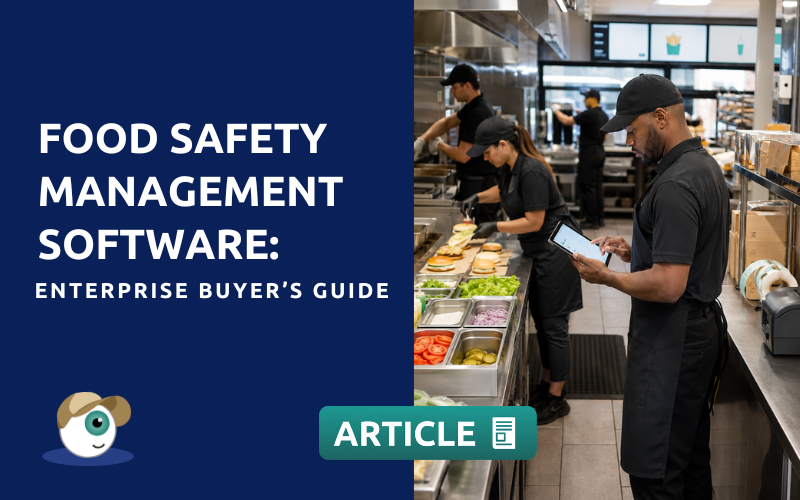
Managing food safety across a company with tens, hundreds or even thousands of locations requires far more than digitising forms.
Effective food safety management software must connect people, processes and data, helping teams prevent risks, respond to incidents and maintain consistent standards across the organisation.
The decision should not be left solely to the IT department. Quality, Operations, Food Safety, Procurement and frontline teams all need to assess whether the solution will work under real operating conditions: during a busy service, in response to an unexpected audit or when the same deviation appears across several locations.
Keep reading to discover what enterprise food safety management software should provide, which questions to ask potential vendors and how to determine whether a platform can grow with your organisation.

Food Safety Management Software: Enterprise Buyer’s Guide
1. Start with operational problems, not a feature list
Before requesting demonstrations, the organisation needs to define what it wants to improve. Buying software without this diagnosis often leads to an impressive collection of features that nobody actually uses. Technology’s traditional victory over common sense.
Initial questions should include:
- Which controls are still completed on paper or spreadsheets?
- How much time does each location spend completing records?
- How are corrective actions communicated and supervised?
- Is there centralised visibility across every location?
- How much work is required to prepare for an audit?
- Which processes create the most errors, delays or non-conformities?
- Do existing systems communicate with each other?
The food safety digital assistant Andy connects and digitises tasks, HACCP records, audits, incidents, action plans, labelling and traceability.
This allows the company to approach food safety as a complete operating system instead of moving isolated forms from a folder to a screen.
2. Evaluate its ability to standardise multi-site operations
Creating a digital form is relatively simple. The real enterprise challenge is ensuring that hundreds of locations follow shared standards without removing the flexibility needed by individual markets, brands or site formats.
The software should allow the organisation to:
- Create processes and templates centrally.
- Distribute updates in a controlled way.
- Adapt tasks by location, country or business unit.
- Manage different permissions and responsibilities.
- Maintain a complete change history.
- Review both local and organisation-wide results.
With Andy’s multi-site dashboard, managers can oversee processes across different locations from one platform and identify which sites require additional support. Head office gains greater control, while local teams receive clear instructions adapted to their operations.
3. Check what happens after a deviation is detected
A digital record confirms that a task has been completed. Genuine food safety management software must also help the organisation decide what to do when the result falls outside the expected limits.
The Codex Alimentarius HACCP system is based on identifying hazards, establishing controls and applying corrective measures when a deviation occurs. The chosen solution should therefore activate specific responses, assign responsible employees and preserve evidence of every action.
With Andy, an incident can automatically trigger:
- A notification to the appropriate person.
- Instructions for carrying out the corrective action.
- A request for photographs or other evidence.
- A resolution deadline.
- Incident monitoring and closure.
- Subsequent analysis of recurring issues.
Connecting detection, action and verification prevents deviations from becoming buried in a report that someone intends to review “when they have a moment” – an exceptionally elastic unit of organisational time.
4. Review traceability and the quality of evidence
Information must be easy to locate, understand and verify. This becomes critical during audits, internal investigations, product withdrawals or requests from customers and regulatory authorities.
ISO 22000 establishes requirements for food safety management systems, covering elements such as communication, system management, hazard control and documented information.
When comparing providers, organisations should check whether the software records:
Who completed each control and when.
Which version of the procedure was in force.
What result was recorded.
Which evidence was attached.
Whether any later changes were made.
Who reviewed and closed the action.
Andy centralises this information and makes it easier to retrieve during audits. Its traceability and labelling tools also help connect products, batches, dates and movements without relying on fragmented records.
5. Prioritise the experience of the teams using the system
A platform can be technically flawless and still fail because it requires too many steps, constant training or the patience of a medieval monk.
Employees with different roles and levels of digital experience should participate in the software trial. Observe whether they can quickly complete tasks, record temperatures, consult instructions and report incidents.
Andy is designed to fit into daily operations through straightforward, guided workflows. Teams receive the information they need at the right moment, while the organisation can provide training materials, procedures and documents through a centralised Library.
The evaluation should also consider:
- Performance across different devices.
- Availability in the required languages.
- Ease of onboarding new employees.
- Clarity of alerts and instructions.
- The actual time needed to complete each process.
6. Analyse integrations, sensors and scalability
The selected platform must fit into the company’s wider technology ecosystem. Buyers should ask about APIs, identification systems, labelling devices, sensors, data exports and business intelligence tools.
Andy connects operational management with solutions such as automated labelling and sensor-based monitoring. Organisations can combine controls completed by employees with automatically captured data, reducing manual work and improving visibility over equipment and critical conditions.
The evaluation must also consider future growth. The right solution should accommodate new locations, processes, brands and countries without requiring the entire configuration to be rebuilt.
7. Questions to ask during a demonstration
Before making a decision, ask the provider to address real operational scenarios:
- How would a new procedure be deployed across 500 locations?
- What happens when a result exceeds an established limit?
- Can recurring incidents be identified by site, process or region?
- How long does it take to retrieve evidence for an audit?
- How are regulatory or procedural updates managed?
- Which integrations are currently available?
- What support is provided during implementation?
- How is organisational data stored and protected?
- Which indicators can senior management access?
Ask the provider to reproduce these scenarios during the demonstration. Attractive screens are pleasant; seeing how the system handles an incident at 8:15 during service is considerably more revealing.
Choose a platform that turns control into prevention
The best food safety management software is not the platform with the longest list of features. It is the one that helps teams work effectively, enables management to understand what is happening across the operation and transforms daily data into preventive decisions and actions.
Andy brings controls, audits, incidents, traceability, labelling, sensors, documentation and analysis together in one environment. This helps enterprises standardise processes, reduce administrative workload and build a more connected, visible and scalable approach to food safety.
Would you like to see how Andy could work across your organisation?
Request a demo and discover how to manage food safety across every location from a single platform.
