

Daily food safety data: signals management should not ignore
Every day, food service teams generate hundreds or even thousands of data points related to food safety: temperature checks, HACCP records, incidents, audits, corrective actions, food labelling processes and traceability movements.
The problem is rarely a lack of information.
The real challenge is turning all this daily food safety data into a clear and useful overview for management.
Recording a temperature confirms that someone completed a check. Analysing hundreds of temperatures over time can reveal where a risk is developing before it becomes an incident.
When data is reviewed collectively, management can understand how operations are really performing, compare locations and make more precise decisions.
Without this combined view, much of the information remains trapped in forms, spreadsheets and records that fulfil a documentary purpose but contribute little to strategy.
Keep reading to discover how to turn this data into more effective decisions.

Daily food safety data: the signals management should not ignore
1. Records are essential, but they need context to create value
In a multi-site operation, daily records are part of normal working routines and reflect the work carried out by teams at every location.
They provide the foundation for food safety and demonstrate that checks are being completed systematically.
The challenge arises when management needs to go one step further and build an overall picture from all that information.
The data exists, but it is not always organised in a way that provides quick answers to important questions:
- Which locations accumulate the highest number of incidents?
- Which checks are missed most frequently?
- Where do the same deviations keep recurring?
- How long does each team take to close a corrective action?
- Which processes create the most errors or administrative work?
Answering these questions requires data to be analysed collectively and according to consistent criteria. When information is reviewed separately or presented in different formats, identifying patterns and comparing results across locations becomes more difficult.
Records fulfil their documentary and operational purpose, but their real potential emerges when they are brought together within a shared overview. Without this analytical layer, information remains fragmented and is harder to translate into clear decisions that improve operations.
2. Averages can hide critical differences between locations
Overall indicators help summarise activity, but they can also soften the appearance of important problems.
A 95% compliance rate may look excellent at an organisational level. However, that figure could conceal one location that completes virtually every check and another that accumulates delays, omissions or incomplete records.
For management, looking only at the overall result can create a sense of control that does not reflect everyday reality. Data should make it possible to compare locations, shifts, teams and types of process.
Some signals worth monitoring include:
- Recurring temperature deviations in the same cold room or piece of equipment.
- Locations with an above-average number of incidents.
- Critical tasks that are consistently completed after the deadline.
- Corrective actions that remain open for too long.
- Significant differences in audit results between similar sites.
These variations do not always indicate a lack of commitment.
They may also point to issues involving training, equipment, planning, workload or process design. The purpose of data is not to distribute blame with administrative enthusiasm, but to identify where intervention is needed.
3. Reviewing data only after an incident limits its value
Many organisations analyse food safety information only after something has happened: an unsuccessful audit, a complaint, a serious deviation or an unexpected inspection. At that point, records become evidence used to reconstruct events.
That function is necessary, but it is not enough.
Daily food safety data should also be used to detect patterns before the problem grows.
A single incident may be an isolated event.
The same incident repeated across several locations or shifts becomes an operational signal. In the same way, a task completed late on one occasion may not be significant. When the delay occurs every week, it probably indicates an issue with planning, resources or the allocation of responsibilities.
Management needs to examine trends, frequency and context. Without this time-based perspective, every error is treated as an independent case and the organisation ends up addressing symptoms while the underlying pattern continues growing quietly behind the scenes.
4. Andy centralises data and turns it into operational visibility
Andy makes it possible to digitise and centralise the main daily food safety processes on one platform: tasks, records, incidents, audits, labelling, traceability, sensors, maintenance and documentation.
This creates a shared source of information for locations, operations managers and management teams. Instead of manually collecting data from different tools, the organisation can access an up-to-date overview of activity and compliance at every site.
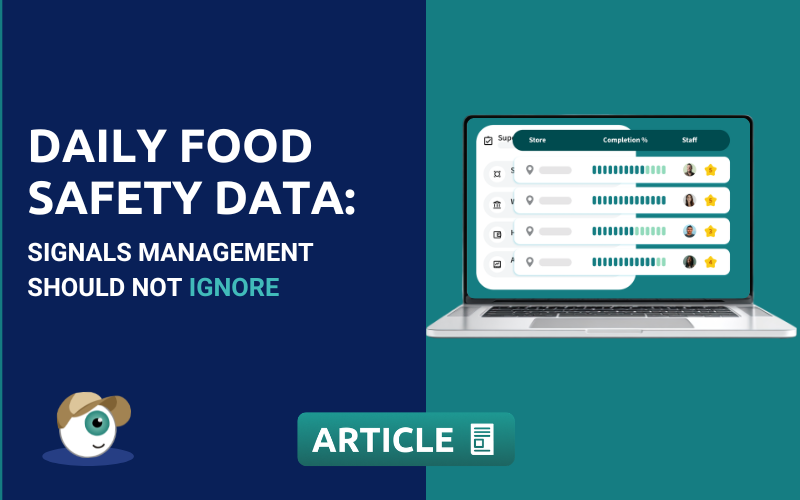
From a multi-site dashboard, management can:
- Compare performance and compliance across locations.
- Identify incomplete records or overdue checks.
- Monitor incidents and corrective actions.
- Detect equipment, processes or locations with recurring deviations.
- Access traceable information for audits and internal reviews.
Centralisation reduces the time spent collecting and consolidating information. It also prevents each site from presenting its data according to different criteria, which might be wonderfully creative in an art exhibition but is less useful when managing food safety.
5. From recording activity to anticipating decisions with Andy
The greatest value appears when information is no longer used only to verify that a task has been completed and starts guiding operational decisions.
With Andy, the data generated every day helps identify patterns, prioritise interventions and direct resources towards the areas presenting the greatest risk or inefficiency. Management can see which locations need support, which processes should be reviewed and where additional training would have a genuine impact.
This overview allows organisations to move from reactive to preventive management. Instead of waiting for an audit to reveal a problem, the organisation can act when the first signals appear:
- Inspect equipment after several temperature deviations.
- Reorganise tasks when delays are concentrated within one shift.
- Update a procedure that repeatedly generates similar incidents.
- Strengthen training at locations with recurring errors.
- Share best practices from the highest-performing locations.
In this way, daily food safety data stops being a historical archive and becomes a tool for continuous improvement. Management gains a more accurate view of operations, while teams receive solutions adapted to the problems they actually face.
Food safety is also managed through data
Daily records contain far more information than first appears. They show which processes work, where difficulties are concentrated, which risks are beginning to recur and which locations need support before a problem escalates.
To make use of this information, management needs centralised, comparable and easy-to-interpret data. Andy connects the daily activity of teams with an organisation-wide operational overview, helping turn routine checks into faster, more preventive and better-informed decisions.
Would you like to discover what the food safety data from your locations is telling you?
