

How to Use Food Safety Audits to Prevent Incidents
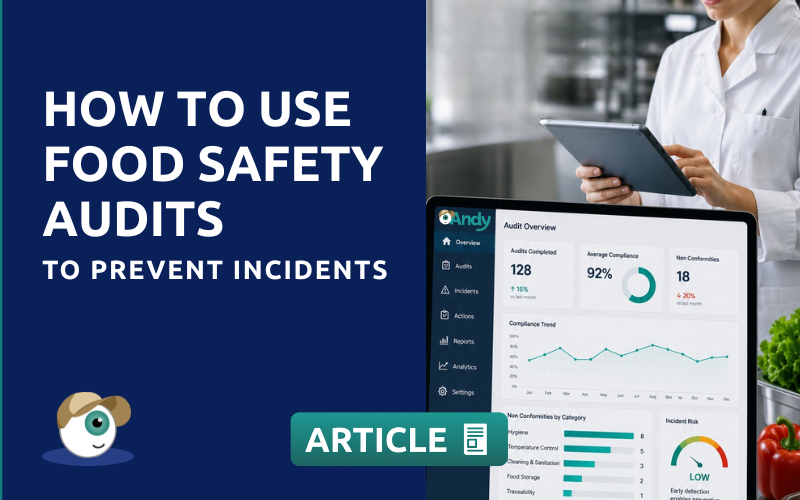
Food safety audits are one of the most important tools for ensuring compliance with procedures, identifying risks and maintaining operational standards across restaurants, hotels, supermarkets and contract catering operations.
However, many organisations still use food safety audits solely as a verification tool. Inspections are carried out, forms are completed and results are filed away until the next review.
The problem is that audits contain a wealth of information that can be used for much more than demonstrating compliance.
When audit data is properly analysed, it can reveal patterns, identify areas of risk and help prevent incidents before they affect daily operations.
Stay with us to find out more.

The problem with treating audits as isolated snapshots
In many businesses, food safety audits are viewed as independent events.
The results of a single audit are reviewed, any issues identified are corrected and the process is considered complete.
However, this approach significantly limits the value of the information collected.
A single audit provides a snapshot of a specific moment in time. The real value emerges when audits are compared over weeks, months or even years.
This is when trends begin to appear.
Processes that are gradually deteriorating. Areas with recurring non-conformities. Equipment or locations that repeatedly show the same weaknesses.
All of this information can serve as an early warning sign of future problems.
Audit data reveals risks before incidents occur
Serious incidents rarely happen without warning.
In most cases, there are early indicators that organisations fail to recognise.
- A department with steadily declining audit scores.
- A procedure that repeatedly generates observations.
- A location that accumulates small deviations across multiple categories.
Viewed individually, these findings may seem insignificant.
However, when analysed together, they can reveal risks long before they become operational incidents or food safety failures.
For this reason, food safety audits represent one of the most valuable sources of information for organisations looking to adopt a more preventive approach to risk management.
The challenge of paper-based audits and disconnected systems
Many organisations still conduct audits using paper forms or disconnected systems.
This makes it extremely difficult to extract meaningful insights from the data.
Comparing historical results, identifying trends or analysing performance across multiple locations often requires significant time and effort.
In some cases, the information is simply archived and never reviewed again.
As a result, food safety audits function only as a compliance exercise when they could become a powerful tool for prevention and continuous improvement.
How Andy turns audit results into actionable insights
Digitising food safety audits allows organisations to unlock the full value of the information generated during every inspection.
Andy centralises audits, records and incidents within a single platform, making information easier to access, analyse and act upon.
Managers can:
- review historical results,
- compare performance across locations
- and quickly identify areas with higher levels of risk.
As a result, audits become more than static reports. They become a continuous source of operational intelligence.
Identifying trends and acting before problems escalate
One of the greatest advantages of digital food safety audits is the ability to identify patterns.
When the same non-conformity appears repeatedly, when a category shows a gradual decline in performance or when multiple locations experience similar issues, teams can intervene before the situation becomes a larger problem.
This approach helps organisations prioritise resources, strengthen training programmes where necessary and implement corrective actions more effectively.
Instead of reacting to incidents that have already occurred, businesses can use food safety audits to anticipate and prevent them.
The future of food safety audits is predictive
Food safety audits will continue to play a vital role in maintaining compliance and operational excellence.
However, their purpose is evolving.
It is no longer enough to verify whether procedures have been followed correctly. Organisations must also use audit data to gain a deeper understanding of their operations and identify future risks.
Businesses that learn to maximise the value of their audit information will be better positioned to reduce incidents, improve consistency across locations and strengthen their food safety standards.
With Andy, food safety audits become more than periodic inspections. They become a strategic tool for continuous improvement, risk prevention and smarter operational decision-making.
Want to unlock the full potential of your food safety audits?
