

Food Safety Alert Management: the Cost of Missing Information
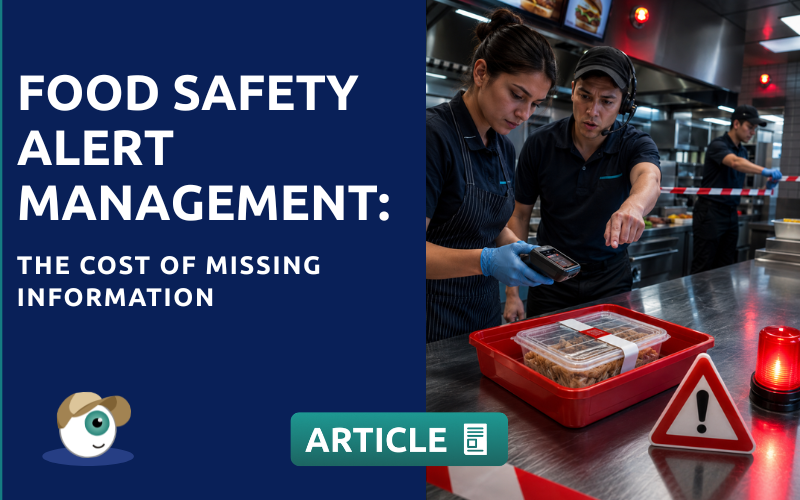
A food safety alert tests much more than a company’s safety protocols. It also reveals how well its information is organised, updated and accessible when it matters most.
Which product is affected? Which batch does it belong to? Which supplier provided it? Which locations received it? When was it used, and what records are available?
If answering these questions requires searching through folders, spreadsheets, emails and paper documents, the alert is no longer solely a food safety issue. It also becomes a problem of time, cost and operational control.
Read on to discover the hidden cost of not having the right information during an alert and how digital management enables a faster, more accurate response.

Food Safety Alert Management: The Cost of Missing Information
Every minute spent searching delays the response
During a food safety alert, time is critical. The organisation must identify and locate the affected product and take action before it is used again or reaches the consumer.
However, in many food service businesses, essential information is scattered across different people, tools and formats. Some data may be stored in the purchasing system, some in printed documents and some in messages exchanged with individual locations.
This fragmentation forces teams to reconstruct events while the alert is already under way. A protocol can be perfectly written and still fail in practice because nobody can find the correct version of the document. Bureaucracy, as usual, demonstrates impeccable timing.
Removing more product than necessary also comes at a cost
When a company cannot determine exactly which batches or locations are affected, it will often take a precautionary approach and withdraw every product that could be connected to the alert.
This decision reduces the immediate risk, but it can cause:
- Waste of unaffected products.
- Unnecessary financial losses.
- Disruption to service.
- Urgent replacement of ingredients or suppliers.
- Additional workload for operations teams.
Accurate traceability makes it possible to define the true scope of the incident. Instead of withdrawing products across the entire network, the company can act on the specific batches and locations connected to the alert.
Limited visibility multiplies the coordination workload
In a multi-site organisation, effective food safety alert management depends on fast, verifiable communication.
Sending an instruction by email or through a messaging group is not enough. Management needs to know who has received the alert, which locations have completed their checks, which products have been isolated and where actions remain outstanding.
Without a centralised system, managers must call each location, collect responses manually and update separate documents. The result is a considerable administrative burden and limited visibility over the real status of the incident.
A slow response increases business risk
The impact of an alert extends beyond the value of the withdrawn product. A delayed or incomplete response can affect business continuity, regulatory compliance, audits, relationships with customers and franchisees, and the reputation of the brand.
After the alert, the company must also demonstrate what happened and how it responded. If records are incomplete or scattered, reconstructing the sequence of decisions can become another internal investigation: who received the alert, when they acted, what they checked and what evidence they recorded.
A traceable digital history supports both the immediate response and the subsequent analysis.
From searching for information to acting on it
Effective food safety alert management requires relevant information to be connected in one environment: products, suppliers, batches, locations, records, tasks, documents and incidents.
With Andy, teams can digitise their operational checks, centralise documentation and access data from any location. During an alert, information no longer depends on a particular folder, an isolated spreadsheet or the memory of the only person who knows where everything is kept.
Management gains visibility over the progress of each action, while every location receives clear instructions and can document the checks it has completed.
True preparedness becomes visible when an alert occurs
Food safety does not depend solely on having protocols. It depends on the ability to implement them using reliable, accessible and up-to-date information.
When data is scattered, the company wastes time searching, unnecessarily expands product withdrawals and multiplies its coordination workload. When information is connected, it can identify the scope of the problem, prioritise actions and document its response more accurately.
Could your organisation locate all the information it needs within minutes of a food safety alert?
Discover how Andy helps centralise operational data, improve traceability and respond with greater control across every location.
